


So, what exactly is a general contractor?
Think of a general contractor, or GC, as the captain of your renovation ship. They're the one person you hire who takes complete ownership of the project, steering it from the initial plans all the way to the final, finished space. They don’t swing every hammer or paint every wall themselves, but they're the ones coordinating the entire crew—the plumbers, electricians, carpenters, and painters—to make sure your vision comes together seamlessly.
What Does a General Contractor Actually Do?

In simple terms, a general contractor is your project's hands-on manager and chief problem-solver. You hire them, and in return, they take on the enormous responsibility of managing the day-to-day chaos of a construction site. Their job is to transform the architectural drawings from a piece of paper into a real, livable space, shielding you from the stress and complexity of the process.
This role involves a huge range of critical tasks that, frankly, most homeowners don't have the time, connections, or expertise to handle on their own.
The Nitty-Gritty: What a GC Manages
The sheer scope of a GC's work is massive. Instead of you spending weeks trying to find, vet, schedule, and then juggle a dozen different tradespeople, your GC handles everything. They make sure the right people are on site at the right time, doing high-quality work in the right order.
Here’s a snapshot of their core responsibilities:
- Hiring and Managing All Subcontractors: Your GC brings in their trusted network of professionals, from framers and drywallers to electricians and plumbers. These are people they’ve worked with before and whose quality they can stand behind.
- Owning the Project Timeline: They build and enforce a master schedule for the entire project. This isn't just a simple calendar; it's a complex plan that ensures one trade’s work doesn’t delay another’s, preventing costly overruns.
- Controlling the Budget: The GC is responsible for tracking every dollar spent—on materials, on labour, on permits. They keep the project aligned with the budget you both agreed on, so there are no nasty surprises.
- Guaranteeing Quality and Code Compliance: This is a big one. They are your eyes and ears on-site, making sure every detail meets professional standards and, just as importantly, complies with the Ontario Building Code.
A great general contractor doesn’t just build things; they build trust. They act as your advocate, making sure the final result not only looks like what you dreamed of but is also built to stand the test of time. They’re the crucial link between your ideas and the complex reality of construction.
Ultimately, the GC is the central hub for all communication and execution. To get a better sense of the kinds of projects a contractor can oversee, you can explore our specific construction services in Toronto. Their expertise is what turns a potentially messy and unpredictable renovation into a smooth and successful one.
What a General Contractor Actually Does
The "director" analogy is a great starting point, but what does a general contractor really do all day? It's definitely not just pointing and telling people where to go. The reality is a high-stakes balancing act, built on four critical pillars that prevent a project from spiralling into chaos.
Think of these responsibilities as the engine of your renovation. They’re what turn a messy, unpredictable process into a finished space that’s not only beautiful but also built to last and financially sound.
Project Planning and Scheduling
At the very core of a GC’s job is building and protecting the master schedule. This isn't just a simple calendar with dates on it; it's a complex roadmap where every single task is interconnected. It’s a lot like conducting an orchestra—each trade has to play its part at the exact right moment for the whole thing to work.
For instance, a GC makes sure the framing is totally finished before the electricians and plumbers show up to run wires and pipes through the walls. More importantly, they ensure those trades pass their city inspections before the drywall crew arrives to cover everything up. This careful sequencing is what prevents infuriating delays and the costly rework that kills budgets.
Budget and Financial Management
Your general contractor is the financial guardian of your renovation. Right from the start, they develop detailed cost estimates, but their job doesn't stop there. They meticulously track every single dollar spent as the project moves forward, from materials and permit fees to every last subcontractor invoice.
This constant oversight is what keeps a project from going off the rails financially. A GC is responsible for:
- Tracking all expenses against the approved budget.
- Processing payments to suppliers and trades on time.
- Giving you regular updates so you always know the financial status.
- Managing change orders and transparently explaining any cost impacts before the work is done.
A good general contractor provides total financial transparency, making sure you always know where your money is going. Their main goal here is to prevent the dreaded “budget creep” that can ruin an otherwise amazing renovation experience.
Team and Subcontractor Coordination
One of a general contractor's most valuable assets is their network of trusted trades. They aren't just scrolling through Kijiji to find the cheapest electrician. They bring in proven, licensed, and insured professionals they've worked with before and whose quality they can stand behind. This alone saves you the enormous headache of trying to vet and hire a dozen different specialists yourself.
Beyond just hiring, the GC is the central communication hub. They handle the daily logistics, making sure materials are on-site when they're needed and that every plumber, tiler, and painter knows exactly what they need to do and when. This active, hands-on management is what turns a group of individual workers into a single, efficient team.
Quality Control and Safety Oversight
Finally, your GC is your quality guarantee on the ground. They are on-site constantly, inspecting the work at every single stage. They’re not just making sure it looks good to you; they’re ensuring it meets the strict, non-negotiable standards of the Ontario Building Code. They’re trained to spot small issues long before they become big, expensive problems.
This hands-on role also means enforcing strict safety protocols on the job site to protect the crew and your property. Their constant presence ensures that every detail, from the foundation right up to the final coat of paint, is done the right way.
Navigating Permits, Subcontractors, and Designers
A great renovation isn't just about the hammers and nails; it's about flawlessly coordinating all the people, paperwork, and plans that make it happen. A general contractor is the central hub for this entire complex network, managing the critical relationships that can quickly overwhelm a homeowner. Think of them as the single point of contact responsible for keeping every moving part in sync.
This coordination is especially crucial when you're dealing with city hall. Navigating the building permit process in a place like Toronto can be a real headache, involving incredibly detailed applications, architectural drawings, and a gauntlet of inspections. An experienced GC already knows the local requirements inside and out. They manage the whole process, ensuring every part of your project is fully compliant and approved before a single wall comes down. This expertise is what prevents those costly stop-work orders and fines later on.
Assembling the Right Team of Trades
Beyond the paperwork, a GC’s most valuable asset is their network of trusted subcontractors. They don't just find any plumber or electrician available that week; they bring in licensed, insured, and proven professionals they’ve built relationships with over numerous projects. Honestly, this vetting process is something most homeowners just don't have the time or industry connections to do effectively.
Your general contractor takes care of:
- Vetting and Hiring: Selecting qualified tradespeople who have a proven track record of high-quality work and reliability.
- Scheduling and Coordination: Making sure the right specialist is on-site at exactly the right time, which prevents delays and keeps the project flowing smoothly from one phase to the next.
- Quality Assurance: Overseeing the work of every single subcontractor to guarantee it meets professional standards and the project’s unique specifications.
This diagram shows how a GC integrates team management with their other core duties.
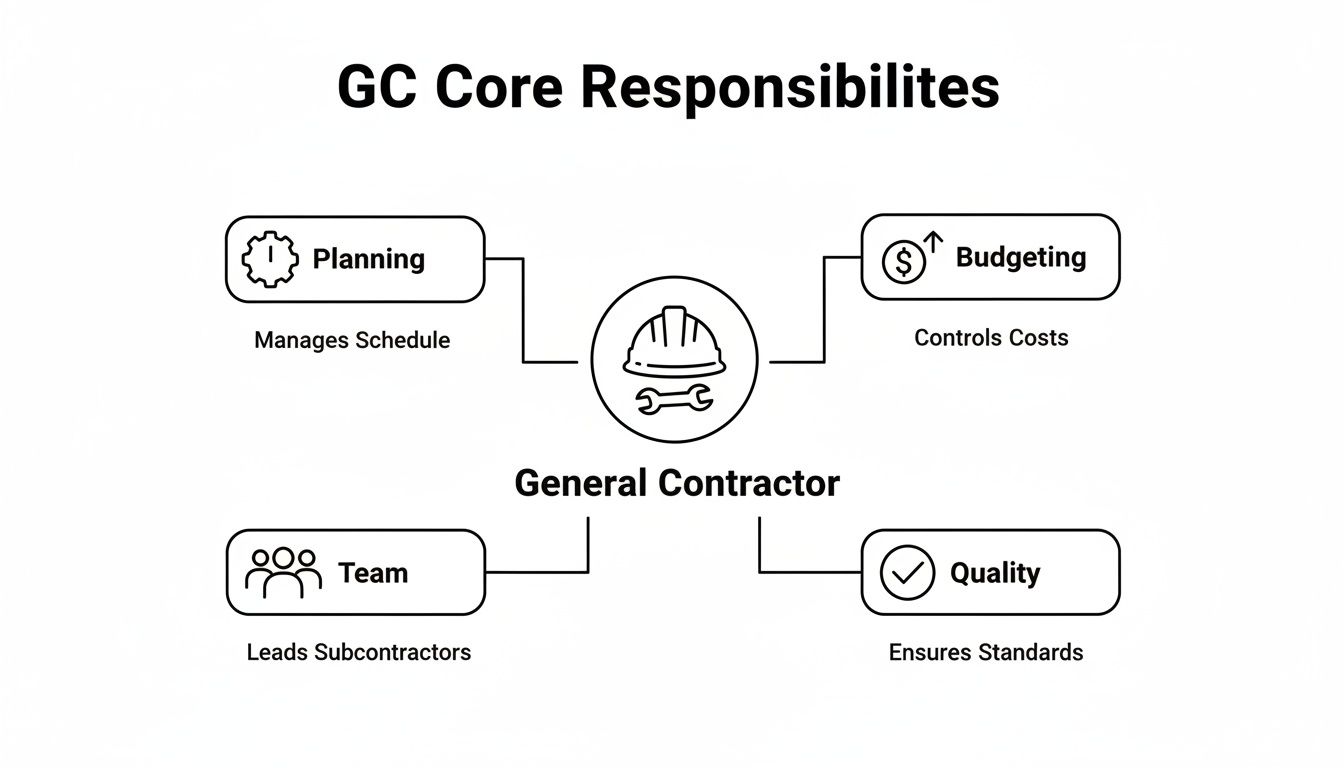
As you can see, managing the team isn't just one isolated task—it’s deeply connected to smart planning, accurate budgeting, and ensuring the final quality is exactly what you expect.
Bridging the Gap Between Design and Reality
Finally, the general contractor plays a pivotal role as the bridge between your designer or architect and the on-site construction crew. While a designer creates the vision, the GC is the one responsible for translating that creative plan into a structurally sound and buildable reality. They'll review architectural drawings for practical feasibility, spotting potential construction issues or opportunities for cost savings before they become expensive problems.
A skilled general contractor doesn't just follow blueprints; they collaborate with the design team to ensure the final product is as functional and durable as it is beautiful. This partnership is fundamental to a successful outcome.
This collaborative spirit is at the heart of what makes the integrated project delivery model so effective. You can learn more about how having a unified team can streamline your entire project by exploring the benefits of a design-build contractor. At the end of the day, this synergy between design and construction is what ensures your vision is executed flawlessly, on time, and within your budget.
Understanding Common Contractor Payment Models
Figuring out how you'll pay your general contractor is a huge piece of the puzzle—just as important as the actual work they’re going to do. The payment structure, or what we call the contract model, really sets the financial rules for your entire project. It determines who's holding the financial risk and just how flexible (or rigid) the budget will be.
Getting your head around these models is the key to picking a partnership that feels right for your project's scope and your own comfort level with budget surprises. You'll almost always run into one of these three main types.
The Fixed Price Contract
A Fixed Price contract is pretty much what it sounds like. Sometimes called a lump-sum agreement, it means your general contractor agrees to get the whole job done for one specific, pre-determined price. Simple as that.
This model is perfect for projects where the scope is crystal clear from the get-go and isn’t likely to change. The biggest win here is budget certainty. You know exactly what you’re paying from day one, which can be a massive relief. The flip side is that this rigidity can sting if you decide you want to make changes mid-project. Any little deviation requires a formal (and often pricey) change order.
The Cost Plus Contract
The Cost Plus model is a totally different beast. With this kind of agreement, you pay for the actual costs of all the labour and materials, plus a fee or percentage that’s been agreed upon beforehand to cover the contractor’s overhead and profit.
This approach gives you way more flexibility and transparency. You get to see every single invoice, so you know precisely where every dollar is going. It's a fantastic choice for more complex renovations where it's tough to nail down the full scope right at the start. The catch? The financial risk shifts more onto you, the homeowner. If lumber prices suddenly spike or the project hits unexpected delays, the final bill can climb higher than the initial estimate.
Choosing a payment model is all about balancing risk and flexibility. A Fixed Price contract locks in your budget but handcuffs you on changes, while a Cost Plus contract gives you adaptability but less budget certainty.
The Time and Materials Contract
A Time and Materials (T&M) contract is a lot like Cost Plus, but you’ll usually see it used for smaller jobs or when the scope is a complete unknown. Under a T&M, you pay an hourly rate for all the labour, plus the direct cost of any materials used.
T&M is great for quick repair jobs or some initial exploratory work to figure out a bigger problem. It’s a fast way to get someone started, but it offers the least amount of budget predictability. We generally wouldn’t recommend it for a large-scale renovation, as the costs could easily spiral out of control without a clear endpoint or a "not-to-exceed" clause built in.
Before we move on, let's break these down in a simple table to see how they stack up side-by-side.
Comparing Contractor Payment Models
This table gives you a quick overview of the most common contract structures, helping you see which might be the best fit for your home renovation.
| Contract Model | Best For | Pros | Cons |
|---|---|---|---|
| Fixed Price | Projects with a clearly defined, unchanging scope. | Budget is predictable and known upfront. The contractor assumes most of the financial risk. | Inflexible. Changes require costly and time-consuming change orders. |
| Cost Plus | Complex, large-scale projects where the full scope is uncertain. | High transparency and flexibility to make changes. You only pay for actual costs. | Less budget certainty. The homeowner assumes more of the financial risk if costs escalate. |
| Time & Materials (T&M) | Small repairs or projects with an undefined scope. | Fast to start and very flexible. Ideal for urgent or exploratory work. | Least predictable budget. Not suitable for large projects without a cost ceiling. |
Each model has its place, and the right one really depends on how much you know about your project before you begin and how comfortable you are with potential budget shifts.
How to Choose the Right General Contractor

Choosing your general contractor is easily the most critical decision you'll make for your entire renovation. It’s the one choice that dictates whether the process is exciting and rewarding or a total nightmare. The right partner protects your home, your investment, and your sanity, while the wrong one can send your budget and timeline completely off the rails.
This decision goes way beyond just collecting a few quotes. You need to dig deeper and really vet their credentials, their communication style, and their past work to find someone you can genuinely trust.
Key Questions to Ask Every Potential Contractor
Before you even think about signing a contract, you need to sit down for a real conversation. Treat it like an interview. This is your chance to see beyond the sales pitch and gauge their actual professionalism, experience, and reliability.
Your questions should cover a few non-negotiable areas:
- Licensing and Insurance: Don't be shy about this. Ask for their business license number, proof of liability insurance, and proof of WSIB (Workplace Safety and Insurance Board) coverage. In Ontario, WSIB is mandatory. It protects you from being on the hook if a worker gets injured on your property.
- Experience with Similar Projects: Have they actually done a project like yours before? Ask to see proof. A great place to start is their online project portfolio, which can give you a quick feel for their quality and style.
- Communication and Process: How will they keep you in the loop? Who’s your go-to person when you have a question? A pro will have a clear system for things like weekly check-ins and a formal process for handling change orders—because they will happen.
A detailed, transparent contract is the foundation of a successful project. If a contractor is hesitant to put everything in writing—from the payment schedule to the specific materials being used—consider it a major red flag. Vague agreements almost always lead to conflict.
Red Flags You Cannot Ignore
Just as important as knowing what to look for is knowing what to run from. Certain behaviours are universal warning signs that a contractor isn't professional or trustworthy. Keep your eyes peeled for these red flags.
- Pressure for Large Upfront Payments: A reputable contractor works with a clear, milestone-based payment schedule. If they’re demanding a massive deposit (anything over 10-15%) before a single hammer is swung, it could be a sign of financial trouble on their end.
- Vague or Incomplete Contracts: The contract should be your project’s bible—incredibly detailed. If it’s missing a clear scope of work, specific material allowances, or a project timeline, just walk away.
- Unwillingness to Provide References: A contractor who is proud of their work and has a history of happy clients will be eager to connect you with them. If they hesitate or only give you ancient contacts, it's a huge concern.
- A "Too Good to Be True" Bid: An unusually low quote is almost always a trap. It often means they're planning to cut corners somewhere, whether it's with cheap materials, uninsured labour, or hitting you with "surprise" costs down the line.
Common Questions About General Contractors
Even after getting the big picture, a few specific questions always come up. Getting these sorted out will help you feel much more confident about bringing a GC onto your project.
What’s the Real Difference Between a General Contractor and a Subcontractor?
Think of it like this: the general contractor is the head coach of your renovation team. You hire them to run the entire project, from start to finish. They are your single point of contact and the one you have a primary contract with.
A subcontractor, on the other hand, is a specialty player—like the electrician, plumber, or drywaller. The general contractor brings these experts onto the team to handle specific parts of the job. Your agreement is with the GC; their agreements are with the subcontractors. It keeps things simple for you.
How Much Does a General Contractor Typically Charge?
Most general contractors charge a management fee that's between 10% and 20% of the project's total cost. This fee isn't just profit; it covers their overhead, the complex job of coordinating everyone, managing risks, and ensuring the project stays on track.
So, for a $100,000 renovation in Toronto, the general contractor's fee would typically be between $10,000 and $20,000 of that total budget.
Quality control is a huge part of a general contractor's job. They're on the hook for making sure every bit of work, including everything done by subcontractors, meets professional standards and the Ontario Building Code.
Is My General Contractor on the Hook for Fixing Mistakes?
Absolutely. One hundred percent. The GC is responsible for the quality of the entire project. That means they are supervising all the trades and making sure the work meets the standards you both agreed on.
If something isn't right, your contractor is the one responsible for getting it fixed. Any professional contract worth its salt will include a clear warranty for their workmanship, so you’re covered long after the final nail is hammered.
Ready to stop worrying about the details and start your renovation with a trusted partner? At Castlegrove Construction, we manage every aspect of your project with clarity and expertise. Contact us today to discuss your vision.